
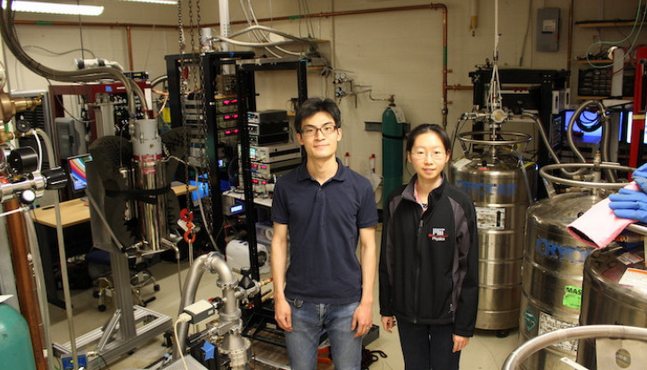
MIT physicists and colleagues have engineered a new property into a well-known family of semiconductors by manipulating ultrathin sheets of the materials only a few atomic layers thick. The MIT team showed that when two single sheets of a TMD, each only a few atomic layers thick, are stacked parallel to each other, the material becomes ferroelectric. In a ferroelectric material, positive and negative charges spontaneously head to different sides, or poles. Upon the application of an external electric field, those charges switch sides, reversing the polarization. In the new materials, all of this happens at room temperature.
Ultra-thin ferroelectrics like those created out of boron nitride and TMDs could have important applications including much denser computer memory storage. But they are rare. With the addition of the four new TMD ferroelectrics reported in Nature Nanotechnology, all part of the same semiconductor family, “we’ve nearly doubled the number of room-temperature ultrathin ferroelectrics,” says Xirui Wang. Further, she noted, most ferroelectric materials are insulators. “It’s rare to have a ferroelectric that is a semiconductor.”

https://statnano.com/news/70611/ Physicists-Engineer-Ferroelectricity-into-Well-known-Family-of-Semiconductors
Comments